
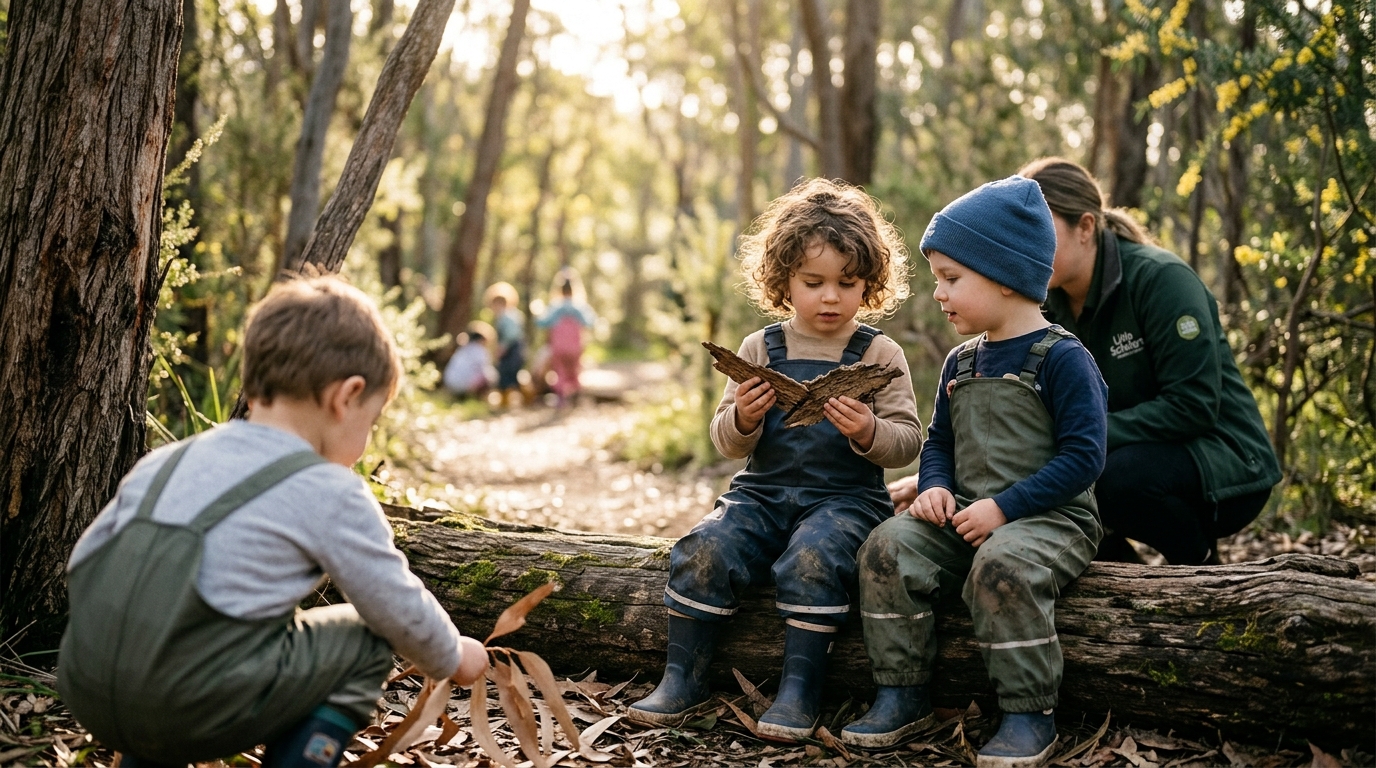
For many Queensland families, the ideal early learning centre is more than a safe place for children to spend the day. It is a setting where children can move, investigate, ask questions, build friendships and develop a genuine connection with the world around them.
That is why more parents are searching for bush kinder, nature play and outdoor learning programs when comparing childcare options in Brisbane, the Gold Coast, Ipswich and Redland Bay. These programs use natural environments, open-ended materials and intentional teaching to turn outdoor experiences into meaningful early education.
At Little Scholars, nature-based learning is supported through outdoor environments, play-based curriculum, STEM experiences, sustainability learning and the Outdoor Explorers program. The exact activities can vary by campus, age group and local environment, so families are encouraged to ask their preferred centre how the program operates.
What does bush kinder mean in early learning?
Bush kinder is an outdoor education approach where children learn in natural settings such as bushland, parks, gardens or other locally relevant outdoor environments. Rather than treating outside time as a break from education, educators use the environment itself as a source of questions, ideas, movement and discovery.
A bush kinder session might include observing insects, collecting fallen leaves for a sorting activity, listening for bird calls, walking over different surfaces, creating imaginary worlds with sticks and seed pods, or discussing how rain changes soil and waterways. The experience is usually play-based, flexible and responsive to what children notice.
Bush kinder does not mean that children are left without guidance. Qualified educators plan experiences, supervise children, assess hazards, adapt activities to developmental abilities and extend learning through conversations. This combination of child-led exploration and intentional teaching is consistent with the Australian Belonging, Being and Becoming: The Early Years Learning Framework.
The approved learning framework recognises that natural outdoor spaces can include plants, trees, gardens, sand, rocks, mud, water and other natural elements. These environments create opportunities for open-ended play, exploration, discovery, managed challenge and connection with nature. ([acecqa.gov.au](https://www.acecqa.gov.au/nqf/national-law-regulations/approved-learning-frameworks?utm_source=openai))
Why nature-based learning matters for young children
Nature programs support several areas of early development at the same time. A single outdoor experience can involve physical coordination, language, early mathematics, creativity, social negotiation and emotional regulation.
1. Physical confidence and gross motor development
Natural environments are rarely perfectly flat or predictable. Slopes, grass, logs, sand, rocks and changing surfaces encourage children to practise balance, coordination, climbing, stepping, reaching and spatial awareness. These experiences can help children become more confident in judging how their bodies move through different spaces.
For babies, outdoor learning may involve feeling grass, noticing sunlight and shade, listening to natural sounds or reaching for age-appropriate sensory materials. For toddlers, it may involve carrying objects, walking along uneven surfaces or experimenting with sand and water. Older children may navigate trails, build structures or take part in gardening and group movement games.
2. Language, curiosity and cognitive development
Outdoor environments provide an almost endless supply of conversation starters. Educators can ask children what they think lives under a log, why a puddle has disappeared, how a seed changes over time or which leaves are similar. These discussions introduce vocabulary, prediction, observation and early scientific thinking in a context children can see and touch.
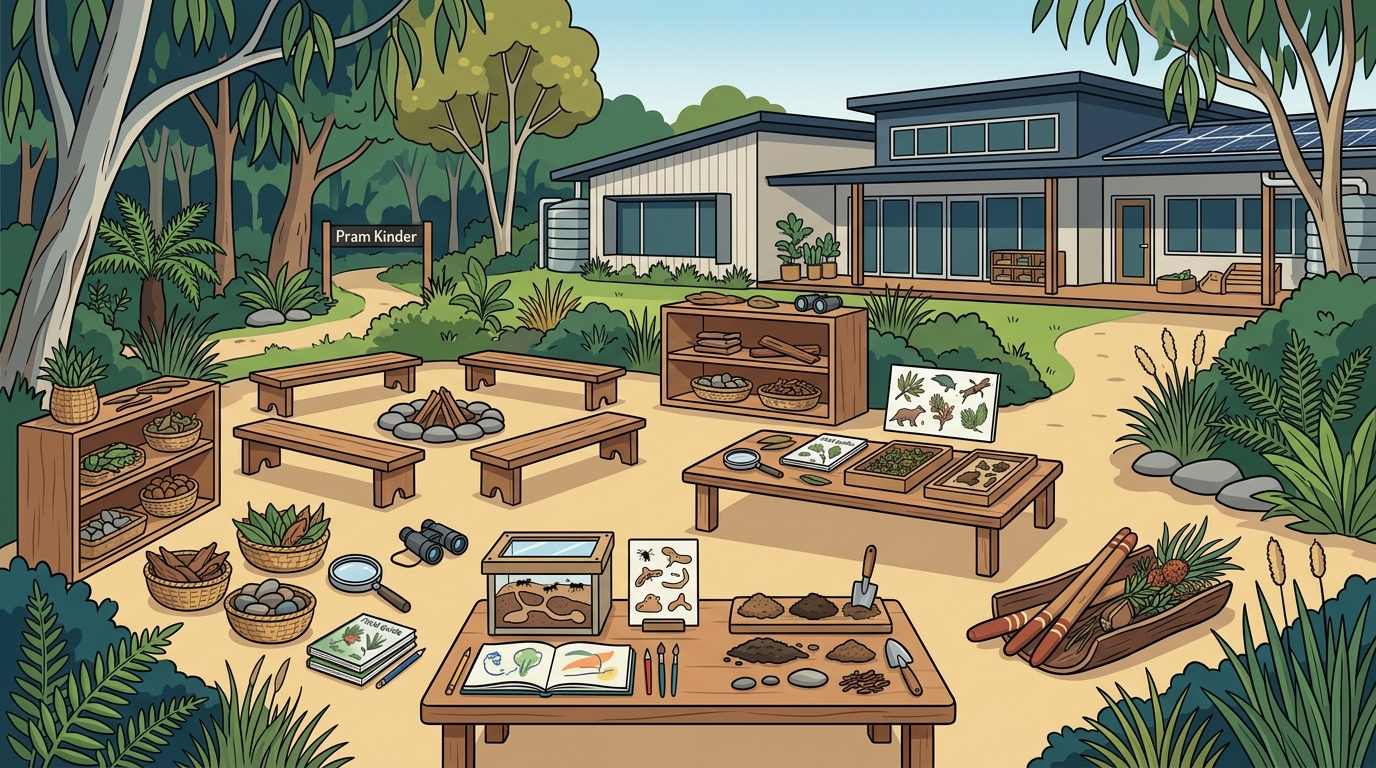
Natural loose parts such as sticks, stones, shells, seed pods and leaves can also be used in open-ended play. One child may turn a stick into a fishing rod, another may use it to mark a path, while a group may use branches to design a shelter. Because the materials do not have one fixed purpose, children practise imagination, planning and problem-solving.
3. Social skills and emotional resilience
Nature play often creates shared challenges that invite children to cooperate. They may work together to transport water, construct a cubby, care for a garden bed or decide how to cross a muddy area. Educators can support children to listen to one another, take turns, negotiate roles and persist when an idea does not work immediately.
Outdoor environments can also give children room to pause, observe and regulate their energy. The sensory qualities of nature—breeze, birdsong, shade, textures and natural light—create a different rhythm from indoor experiences. ACECQA notes that outdoor engagement can provide babies and young children with opportunities for sensory-motor development, social exchange, relationship building and language learning. ([acecqa.gov.au](https://www.acecqa.gov.au/qa3-babies-and-outdoor-play?utm_source=openai))
4. Environmental responsibility
Children are more likely to develop care for the environment when sustainability is part of everyday practice. Planting herbs, reducing waste, reusing natural materials, observing living things and learning to leave habitats undisturbed can help children understand that people, plants, animals, water and land are connected.
This learning can be connected to the EYLF outcome that children become socially responsible and show respect for natural and constructed environments. ([acecqa.gov.au](https://www.acecqa.gov.au/sites/default/files/2020-05/belonging_being_and_becoming_the_early_years_learning_framework_for_australia.pdf?+gold+sponosrship=&utm_source=openai))
What might children do in a bush kinder or nature program?
Activities depend on the centre, local surroundings, weather, educator planning and the children’s interests. A quality program is not defined by one particular activity; it is defined by how intentionally educators use outdoor experiences to support learning and wellbeing.
Nature observation
Children may look for signs of insects, compare leaves, watch clouds, listen for birds or document changes in a garden. These experiences build observation skills and encourage children to ask questions.
Gardening and sustainability
Children may plant seeds, water herbs, harvest edible produce, investigate composting or discuss what plants need to grow. Gardening can introduce early science, responsibility and food awareness.
Loose-parts construction
Natural materials can become bridges, nests, shelters, roads, patterns or imaginative props. Educators can extend the experience with questions about balance, weight, shape, length and design.
Movement and exploration
Walking, climbing, balancing, digging, carrying and navigating different surfaces allow children to practise physical skills while developing confidence and body awareness.
Creative expression
Children may use mud, natural pigments, leaves, sticks or found textures in art, music, storytelling and dramatic play, creating connections between nature and the arts.
Connection to Country
Outdoor learning can support age-appropriate conversations about local places, community, Traditional Custodians and respectful relationships with land and living things.
How Little Scholars brings nature into early learning
Little Scholars is a family-owned early learning provider with purpose-built campuses across South East Queensland, including the Gold Coast, Brisbane, Ipswich and Redland Bay. Its curriculum combines play-based learning with experiences designed to support children’s physical, social, emotional, language and cognitive development.
Outdoor Explorers and bush kinder experiences
The Little Scholars Outdoor Explorers program is designed to give children meaningful opportunities to explore local natural environments. Depending on the campus and children’s age, educators may facilitate nature walks, sensory discovery, environmental investigations, movement experiences, imaginative play and learning with natural materials.
Families should ask their local campus about the age groups involved, session frequency, excursion arrangements, locations and the activities currently planned. A nature program for infants will look different from one designed for children preparing for school.
STEM learning through real-world discovery
Nature provides practical contexts for early STEM learning. Children can investigate how water moves, compare the size and texture of objects, notice patterns in leaves, test which materials float, design a structure or observe the life cycle of a plant.
These experiences make abstract ideas tangible. Children are not simply being told about measurement, cause and effect or design; they are exploring those concepts through play and conversation. Educators can document children’s theories, revisit questions over time and plan follow-up experiences based on emerging interests.
Respectful cultural learning and Acknowledgement to Country
Connection to the natural world can be strengthened when children learn about the history and culture of the place where they live and learn. Little Scholars provides opportunities for children and educators to learn about Aboriginal and Torres Strait Islander cultures and the Traditional Custodians of the land through its Acknowledgement to Country approach.
According to Little Scholars, children may engage with First Nations perspectives through traditional song, dance, storytelling and learning about meaningful connections to Country. Families can ask their centre team how local cultural knowledge is incorporated respectfully into the curriculum and daily practice.
Nature learning beyond the core day
For school-age children, outdoor exploration can also form part of a broader before-school, after-school or vacation care experience. Little Scholars’ Before and After School Care programs are designed to provide care, social interaction and engaging activities outside school hours. The specific outdoor experiences available depend on the campus program and daily conditions.
How to compare early learning centres with nature programs
Many centres use terms such as nature play, outdoor learning, bush kinder or environmental education. These terms can describe different levels of commitment, so it is useful to ask practical questions before enrolling.
| What to investigate | Questions to ask during a tour |
|---|---|
| Frequency | How often do children participate in nature-based experiences, and are they part of the regular program? |
| Age suitability | How are activities adapted for babies, toddlers, kindy children and school-age children? |
| Learning purpose | What skills or learning outcomes are educators supporting through outdoor experiences? |
| Safety and supervision | How are hazards assessed, ratios maintained, boundaries established and emergencies managed? |
| Weather planning | What happens during heat, heavy rain, storms or poor air quality, and what clothing or equipment is required? |
| Local environment | Do children use the centre garden, nearby parks, bushland or other community spaces? |
| Cultural respect | How are local Traditional Custodians and First Nations perspectives included? |
| Family communication | How are children’s discoveries, observations and learning shared with families? |
Managed risk versus avoidable hazard
Nature-based learning should include challenge, but challenge must be planned and supervised. Managed risk can help children develop judgement—for example, deciding how to step over a branch or how to carry water safely. Educators should distinguish this from hazards that are uncontrolled or unnecessary.
Ask how the centre conducts risk-benefit assessments, checks outdoor spaces, manages allergies and sun exposure, handles insects and plants, and adjusts experiences for individual children. A clear answer is an important sign that outdoor learning is being approached professionally.
Look for a whole-campus philosophy
A strong nature program is usually connected to other parts of the curriculum rather than operating as an isolated activity. Look for links between outdoor play, STEM, sustainability, literacy, school readiness, cultural learning, nutrition and family engagement.
For example, a child might observe a seedling outdoors, draw it in a journal, measure its growth, discuss what it needs to live, read a related story and help prepare vegetables harvested from the garden. This type of connected learning reflects the holistic and integrated approach encouraged by the EYLF. ([acecqa.gov.au](https://www.acecqa.gov.au/information-sheet-eylf-practices-holistic-integrated-and-interconnected-approaches?utm_source=openai))
Bush kinder compared with ordinary outdoor play
All quality early learning services should provide children with outdoor experiences. Bush kinder or a dedicated nature program generally goes further by making the natural environment a deliberate context for learning.
| Ordinary outdoor play | Dedicated bush kinder or nature program |
|---|---|
| May take place mainly in a fixed playground. | May include gardens, bushland, parks or other natural settings. |
| Often focuses on free movement, social play and recreation. | Combines child-led play with intentional environmental learning. |
| Uses a mixture of commercial equipment and toys. | Places greater emphasis on natural loose parts and open-ended materials. |
| Learning opportunities may arise spontaneously. | Educators plan, observe, document and extend nature-based learning. |
| Outdoor time may be reduced when conditions change. | Programs usually have documented weather, clothing and contingency procedures. |
The two approaches are not opposites. A high-quality centre can provide daily outdoor play while also offering more structured nature investigations or excursions. The most important consideration is whether the program is safe, inclusive, developmentally appropriate and genuinely connected to children’s learning.
Key takeaways for families
- Yes, early learning centres with bush kinder and nature programs exist in Queensland. Availability, format and frequency vary by provider and campus.
- Bush kinder is more than playground time. It uses natural environments as a context for intentional, play-based learning.
- Nature supports multiple areas of development. Children can build physical confidence, language, creativity, problem-solving, cooperation and environmental awareness.
- Infants can participate too. Their experiences should be adapted to their developmental stage and may focus on sensory discovery, movement, relationships and belonging.
- Safety should be transparent. Ask about supervision, risk-benefit assessments, weather procedures, sun protection, allergies and emergency planning.
- Look for cultural responsibility. Nature programs should support respectful learning about Country and Aboriginal and Torres Strait Islander cultures.
- Little Scholars offers Outdoor Explorers experiences. Families can contact their preferred South East Queensland campus to confirm current program details.
- A centre tour is the best next step. You can see the outdoor spaces, meet educators and ask how nature learning is incorporated into your child’s day.
Frequently asked questions
Are there early learning centres with bush kinder programs?
Yes. Some early learning centres offer dedicated bush kinder, outdoor learning or nature-based programs. Little Scholars offers an Outdoor Explorers program, with availability and delivery details dependent on the individual campus and age group.
What age can children start nature-based learning?
Children can engage with nature from infancy, provided experiences are planned around their developmental abilities and wellbeing. Babies may explore natural textures, sounds, light and movement with an educator, while toddlers and older children can participate in increasingly active investigations, gardening, construction and nature walks.
Is bush kinder suitable for babies?
Yes, when the experience is age-appropriate and carefully supervised. For babies, outdoor learning may involve sensory-motor exploration, time in natural shade, listening to sounds, looking at plants and animals from a safe distance, and responsive interaction with educators. ACECQA identifies outdoor experiences as opportunities for sensory development, social exchange and language learning for babies. ([acecqa.gov.au](https://www.acecqa.gov.au/qa3-babies-and-outdoor-play?utm_source=openai))
How is bush kinder different from outdoor play?
Outdoor play may include free movement and social play in a centre’s playground. Bush kinder or a dedicated nature program intentionally uses natural environments, materials and events as part of the educational program. Educators observe children’s interests, ask questions, introduce concepts and document learning.
Is nature-based childcare safe?
It can be safe when qualified educators plan the environment, maintain appropriate supervision, identify hazards and use risk-benefit assessments. Nature-based learning may include managed challenge, but centres should have clear procedures for boundaries, weather, sun protection, allergies, first aid, excursions and emergencies. Ask these questions when visiting a centre.
What happens during bad weather?
Each centre sets its own procedures. Some outdoor experiences may continue in light rain or cooler conditions with suitable clothing, while storms, extreme heat or other unsafe conditions may require children to remain in protected areas or move indoors. Ask your preferred Little Scholars campus how it manages weather and what families need to provide.
How does Little Scholars include Indigenous perspectives?
Little Scholars supports learning about Aboriginal and Torres Strait Islander cultures, Traditional Custodians and connection to Country through its Acknowledgement to Country approach. Families can speak with educators about how local perspectives, stories, songs, dance and environmental learning are incorporated respectfully at their campus.
Can school-age children access outdoor activities through before and after school care?
Little Scholars provides Before and After School Care and vacation care. Activities vary by campus, but school-age programs may include outdoor play, social experiences and opportunities to continue exploring the environment outside the regular school day.
How can I see a Little Scholars nature program?
The best way is to book a tour at a convenient Little Scholars campus. During your visit, ask to see the outdoor learning areas, discuss the Outdoor Explorers program, meet the educators and find out how the experience is adapted for your child’s age.
Explore nature-based learning at Little Scholars
If you are looking for childcare that combines education, outdoor exploration and responsive relationships, Little Scholars may be worth exploring. With campuses across Brisbane, the Gold Coast, Ipswich and Redland Bay, families can speak with their local team about Outdoor Explorers, bush kinder experiences, gardens, STEM learning, sustainability and age-appropriate outdoor play.
Book a tour to visit a Little Scholars campus, meet the educators and discover how nature can become part of your child’s everyday early learning experience.