
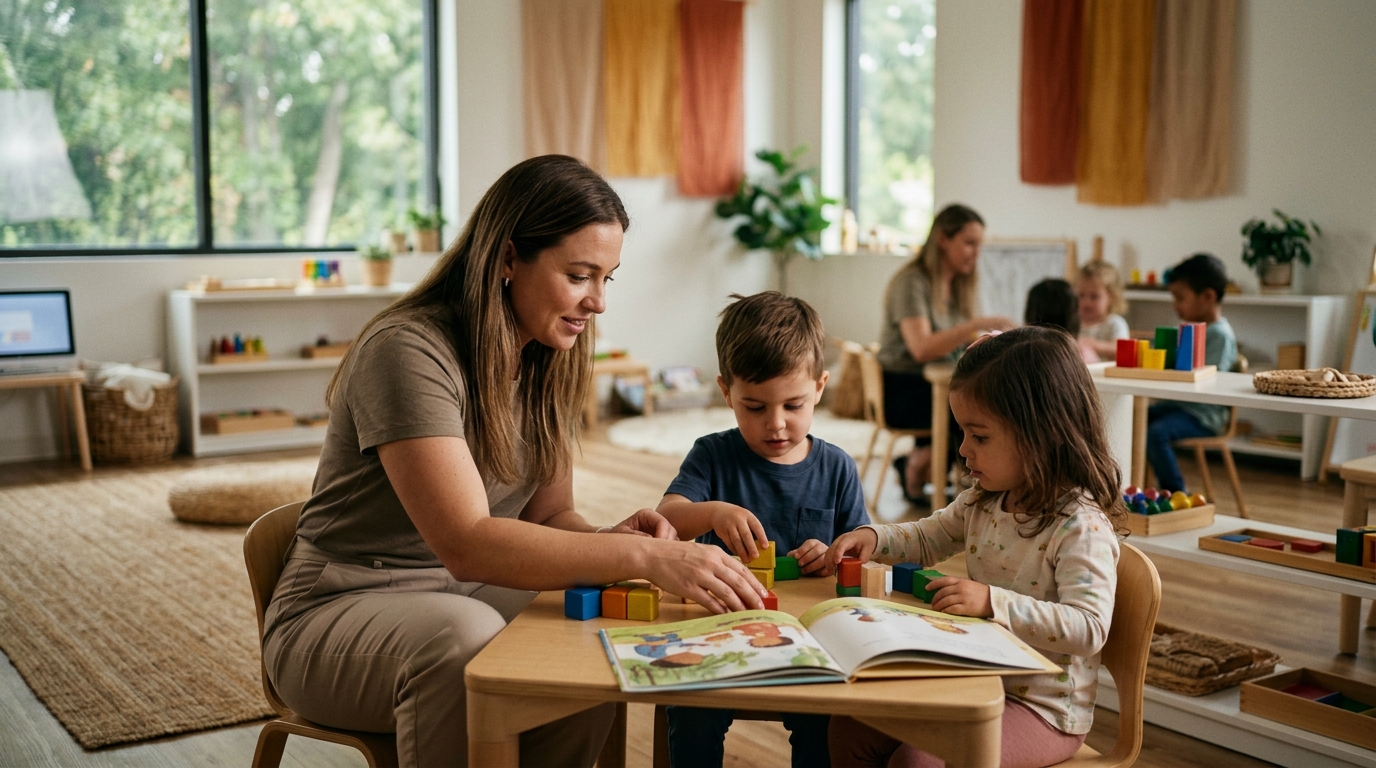
When parents compare early learning centres, they often look beyond opening hours, meals and location. They want to know how educators will help their child build language, confidence, relationships, curiosity and the foundations for school.
The Abecedarian Approach Australia is one framework families may encounter during that search. It is best understood not as a worksheet-based preschool program, but as a relationship-led way of turning everyday interactions into meaningful learning opportunities. A conversation during nappy change, a shared book before lunch, a question asked while children investigate sand or water, and a game designed around a child’s interests can all become intentional learning experiences.
For families exploring childcare in Queensland with Little Scholars, understanding the approach can make it easier to ask informed questions on a centre tour and identify whether an educational philosophy is visible in daily practice.
The short answer: how helpful is the Abecedarian Approach?
The Abecedarian Approach can be highly helpful when it is implemented consistently by skilled educators who know each child well. Its greatest strength is that it focuses on the quality of adult-child interactions. Rather than waiting for formal lessons, educators use warm, responsive communication and carefully planned experiences to support children’s language, thinking, social development and independence throughout the day.
It is particularly useful because it can begin in infancy and be adapted for different ages, abilities, interests and cultural backgrounds. Babies, toddlers and kindergarten-aged children do not need identical activities; they need appropriately responsive interactions that extend what they can already do.
However, the approach is not a guarantee of a particular school result, and it should not replace play, secure relationships, family involvement, cultural responsiveness or professional judgement. In Australia, a strong program should work alongside the approved Belonging, Being and Becoming: The Early Years Learning Framework V2.0, rather than operate as an isolated academic system. Under the National Quality Framework, services must provide an educational program based on an approved learning framework and responsive to each child’s developmental needs, interests, experiences and individual differences. ACECQA’s approved learning framework guidance explains this national requirement.
What is the Abecedarian Approach?
The Abecedarian Approach grew from the Abecedarian Project, a long-running early childhood research program in the United States. The central idea is simple: children learn through frequent, positive and purposeful interactions with responsive adults.
In practice, the approach helps educators move from general supervision to intentional engagement. An educator might notice that a toddler is interested in vehicles, then use that interest to introduce words such as “wheel,” “fast,” “under” and “stop”; encourage turn-taking; count objects; and support the child to explain what is happening. The learning is embedded in play and relationships, but it is not accidental.
The approach is often described through four connected elements:
- LearningGames: short, playful experiences that target a child’s emerging skills.
- Language Priority: rich, responsive conversation woven through routines and play.
- Conversational Reading: interactive book sharing in which children participate, predict, comment and connect ideas.
- Caregiver-Child Interactions: warm, responsive exchanges that build attachment, communication and learning.
These elements are flexible. They can be used with a baby during floor play, a toddler preparing fruit with an educator, or a kindergarten child explaining a design made from blocks.
How the four elements appear in an early learning day
1. LearningGames turn development goals into play
LearningGames are brief, enjoyable activities matched to a child’s developmental level. They may support memory, attention, imitation, early numeracy, motor skills, problem-solving or social communication.
For example, an educator may hide a familiar toy under one of two cloths and invite an infant to find it. With an older child, the educator could create a sorting game using natural materials, ask the child to predict which objects will roll down a ramp, or encourage a small group to invent rules for a cooperative game.
The important feature is not the equipment. It is the educator’s ability to observe what a child is ready to practise, offer an achievable challenge and respond positively to the child’s effort.
2. Language Priority makes ordinary moments educational
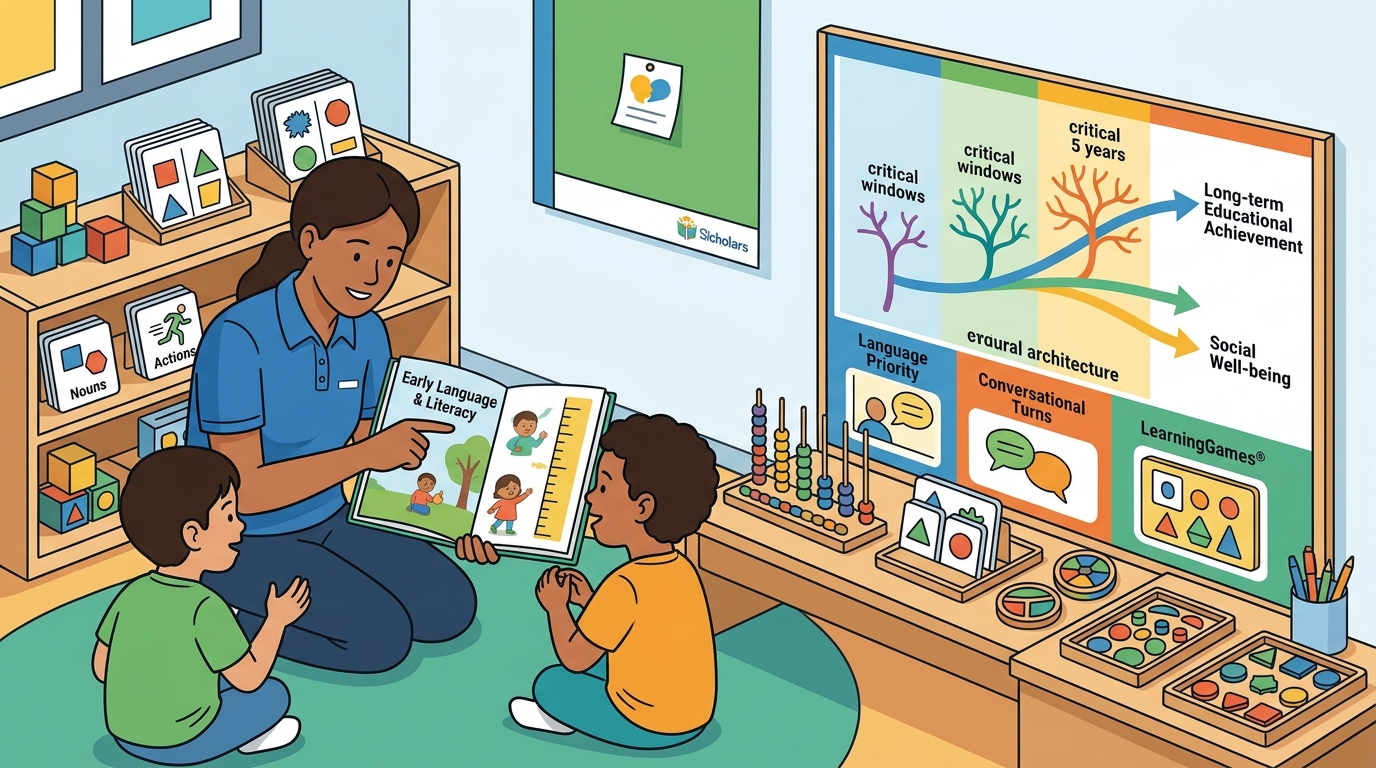
Language Priority means educators deliberately create many opportunities for children to hear, understand and use language. This includes naming objects, describing actions, extending children’s sentences, asking open-ended questions, introducing new vocabulary and allowing enough time for children to respond.
In an infant room, this may sound like a calm description of what is happening during feeding or dressing. In a toddler room, it may involve talking about texture, size and position while children explore playdough. In a kindergarten room, educators may encourage children to justify an idea, retell an experience or explain how they solved a problem.
Quality language interaction is reciprocal. Children are not simply expected to repeat words; they are encouraged to communicate in ways that are meaningful to them, including gestures, home languages, visual supports and developing speech.
3. Conversational Reading builds more than print awareness
Conversational Reading treats books as a shared exchange rather than a one-way performance. Educators invite children to point, predict, answer, question, relate the story to their own experiences and notice details in pictures and print.
A baby may explore a board book while an educator labels pictures and follows the child’s gaze. A toddler may be asked what a character could do next. A kindergarten child may compare two characters’ feelings, identify a beginning-middle-end sequence or create a different ending.
This kind of reading supports vocabulary, comprehension, listening, memory, imagination and enjoyment of books. It also helps educators learn what children understand and where they may benefit from additional support.
4. Caregiver-child interactions provide the foundation
The approach places strong value on affectionate, attentive and responsive relationships. Children learn more readily when they feel safe, known and supported. Educators observe children’s cues, respond to communication attempts, share attention, provide encouragement and adjust the level of help.
These interactions matter during every part of the day, including arrivals, meals, rest, transitions, outdoor play and departures. A secure relationship is not separate from learning; it is one of the conditions that makes exploration and participation possible.
How does it fit the Australian early learning context?
In Australia, the Abecedarian Approach needs to be interpreted through the National Quality Framework, the Early Years Learning Framework V2.0 and each service’s knowledge of its children, families and community.
The Australian framework recognises play-based learning as a context in which children actively make sense of their social worlds, test ideas, create, imagine, solve problems and build relationships. ACECQA’s guidance on play-based learning and intentionality also describes how educators can deliberately use questions, modelling, explanations, speculation and demonstrations to extend learning through play.
This creates a natural connection with Abecedarian practice. Both approaches value children’s agency, meaningful relationships, purposeful educator involvement and learning that is connected to children’s interests. The difference is that the Abecedarian Approach gives educators a particularly clear set of interaction strategies for strengthening language, communication and development.
Australian implementation should also be culturally safe and inclusive. Children’s identities, family knowledge, home languages, community connections and Aboriginal and Torres Strait Islander perspectives should be respected and meaningfully reflected in the program. A framework is most effective when it is adapted thoughtfully, not applied as a rigid script.
At Little Scholars, the Abecedarian reading approach forms part of a broader play-based and holistic curriculum. It sits alongside school-readiness and STEM experiences, outdoor learning, cultural learning and signature programs such as Bush, Beach & Pram Kinder, the Intergenerational Grandfriends program and Wondernest VR.
Potential benefits for children
Stronger early communication
Frequent back-and-forth interaction gives children more opportunities to listen, understand, express ideas and learn new words. For children developing speech, multilingual children and children who communicate in different ways, a responsive approach can help educators recognise and build on every communication attempt.
Greater engagement and curiosity
When experiences are connected to a child’s interests and offered at the right level of challenge, children are more likely to participate actively. A child who is fascinated by insects, ramps, music or cooking can use that interest as a pathway into science, mathematics, literacy, creativity and social learning.
More individualised support
Observation and ongoing assessment help educators identify what each child can do, what they are beginning to understand and what support may help next. This makes planning more responsive than offering the same activity to every child regardless of readiness.
Positive relationships and emotional development
Warm interactions help children practise turn-taking, shared attention, cooperation, emotional expression and self-regulation. Educators can model language for negotiating, acknowledge feelings and help children repair relationships after conflict.
A stronger foundation for school participation
The approach may support capabilities that are useful when children begin school, including listening, communicating, following ideas, persisting with challenges, asking questions and participating in group experiences. School readiness is broader than knowing letters and numbers; it also includes confidence, independence, wellbeing and the ability to engage with others.
It is important to describe these as developmental benefits and foundations, not promises of guaranteed academic performance. Children’s outcomes are influenced by many factors, including health, relationships, temperament, family circumstances, inclusion supports and the quality and continuity of experiences over time.
What should families look for when visiting a centre?
The name of a framework matters less than how it is visible in the room. During a tour, families can ask educators to explain how their approach works with real children and real routines.
- Ask how educators extend children’s language. Do they describe conversations, shared reading, songs, storytelling and intentional questions?
- Ask how planning is individualised. Can educators explain how observations influence the next experiences offered to a child?
- Watch interactions, not just facilities. Are educators attentive, warm and responsive? Do they follow children’s cues and allow time for children to communicate?
- Look for meaningful play. Are materials open-ended and accessible? Do children have opportunities to explore, create, investigate and solve problems?
- Ask how families contribute. Does the service share learning progress and invite families to contribute cultural knowledge, goals and information about their child?
- Check how inclusion is supported. Ask how the centre adapts experiences and environments for different abilities, communication styles and support needs.
- Ask how the approach connects with the EYLF. A quality service should be able to explain how its philosophy, observations and curriculum align with Australia’s approved learning framework.
ACECQA notes that intentional teaching involves deliberate, purposeful and thoughtful decisions, while play-based learning gives children opportunities to discover, create, improvise, test theories and imagine. Families can use these ideas as a practical lens when comparing centres.
What the Abecedarian Approach does not mean
A balanced view is important. The Abecedarian Approach does not mean children spend the day completing formal lessons, sitting at tables or being pushed into academic tasks before they are ready.
It also does not mean every interaction must be adult-directed. Children need uninterrupted time, agency, free exploration, quiet moments, physical activity, imaginative play and opportunities to lead their own learning. The educator’s role is to notice when to observe, when to join, when to model, when to ask a question and when to step back.
Nor is a named approach a substitute for high-quality staffing, stable relationships, safe environments, thoughtful leadership and genuine partnerships with families. The most helpful implementation is flexible, culturally responsive and grounded in professional observation.
ACECQA’s guidance on educational programs emphasises that planned and unplanned experiences, routines and interactions can support learning. Its guidance on learning environments likewise highlights flexible resources that encourage children to explore, create, construct, build relationships and solve problems. These principles reinforce the value of embedding learning across the whole day rather than treating education as a separate activity.
Abecedarian Approach and a general childcare program: what is the difference?
| Area | Abecedarian-informed practice | A basic care-focused program |
|---|---|---|
| Adult role | Educators intentionally join interactions, scaffold learning and respond to individual cues. | Educators primarily supervise routines and maintain safety, with less explicit emphasis on interaction strategies. |
| Language | Conversation, vocabulary, shared attention and interactive reading are prioritised throughout the day. | Language experiences may occur, but they may not be planned or consistently extended. |
| Planning | Observations inform tailored experiences and next steps for individual children. | Activities may be mainly group-based or selected without detailed individual follow-up. |
| Play | Play remains enjoyable and child-responsive while educators intentionally support learning. | Play may be offered primarily as entertainment or to occupy children between routines. |
| Family partnership | Families are invited to share goals, culture, knowledge and information about their child’s learning. | Communication may focus mainly on attendance, meals, sleep and daily care information. |
This comparison is a guide, not a judgement about every centre. Many Australian services use a blended approach and provide thoughtful learning without using the Abecedarian name. Families should assess what educators do, how children are treated and how learning is documented.
Key takeaways for Queensland families
- The Abecedarian Approach is a relationship-based early learning model centred on responsive adult-child interaction.
- Its four commonly recognised elements are LearningGames, Language Priority, Conversational Reading and caregiver-child interactions.
- It can be used from infancy through the kindergarten years and adapted to individual development.
- Its focus on language, shared attention, play and intentional teaching aligns well with the principles of Australia’s EYLF V2.0.
- The approach is most effective when educators apply it flexibly, respectfully and consistently rather than as a rigid lesson plan.
- Families should look for evidence in everyday interactions, planning, shared reading, inclusion and communication with families.
- It supports school-readiness foundations, but no early learning approach can guarantee a particular future academic outcome.
- At Little Scholars, Abecedarian reading is part of a wider holistic curriculum designed to support children’s wellbeing, learning, identity and sense of belonging.
Frequently asked questions
Is the Abecedarian Approach suitable for babies and infants?
Yes. The approach can begin in infancy through responsive caregiving, shared attention, imitation, songs, simple games, talking during routines and interactive book experiences. For babies, learning is closely connected to secure relationships, sensory exploration and communication through sounds, gestures, facial expressions and movement.
Is the Abecedarian Approach the same as formal teaching?
No. It is generally embedded in play, routines and relationships. Educators are intentional about what they say, offer and observe, but children still need agency, active exploration and uninterrupted play. This is consistent with the Australian emphasis on play-based learning and intentionality.
How does Abecedarian differ from Montessori?
Both approaches can value individual development and active learning, but they organise practice differently. Abecedarian-informed practice places particular emphasis on responsive adult-child communication, language-rich interaction, conversational reading and short learning experiences. Montessori environments commonly place stronger emphasis on prepared materials, independence and self-directed activity. The quality of implementation matters more than labels alone.
Does it help children prepare for school?
It can support foundations that are useful for school, such as communication, listening, persistence, social participation, self-regulation, problem-solving and familiarity with books. A high-quality school-readiness program should also support wellbeing, independence, physical development, identity and positive attitudes toward learning.
Can children with additional needs participate?
Yes. The approach can be adapted through changes to communication methods, pacing, materials, sensory demands, group size and educator support. Families should discuss their child’s strengths, needs, goals and any professional recommendations with the centre before enrolment.
How can parents use Abecedarian ideas at home?
Parents can talk with children during everyday routines, follow their interests, share books interactively, pause for responses, introduce new words naturally, play turn-taking games and respond warmly to communication attempts. Short, enjoyable interactions repeated throughout the day are often more practical than trying to create formal lessons at home.
How can I see the approach at Little Scholars?
The best way is to visit a campus and ask educators to show how language, reading, play and individual planning are incorporated into the day. Families can book a tour to discuss their child’s needs and see the learning environment in person.
See how intentional early learning can look at Little Scholars
Choosing an early learning centre is a personal decision. Families may want to consider the quality of relationships, educator qualifications, communication, meals, outdoor spaces, routines, inclusion practices and how the curriculum responds to their child’s interests.
Little Scholars supports children from six weeks to school age across purpose-built campuses in South East Queensland, including the Gold Coast, Brisbane, Ipswich and Redland Bay. Our program combines the Abecedarian reading approach with play-based learning, STEM, school-readiness experiences, outdoor programs and family-focused support.
Explore our campus locations to find a centre near your family, or schedule a tour and speak with the team about your child’s early learning journey.