
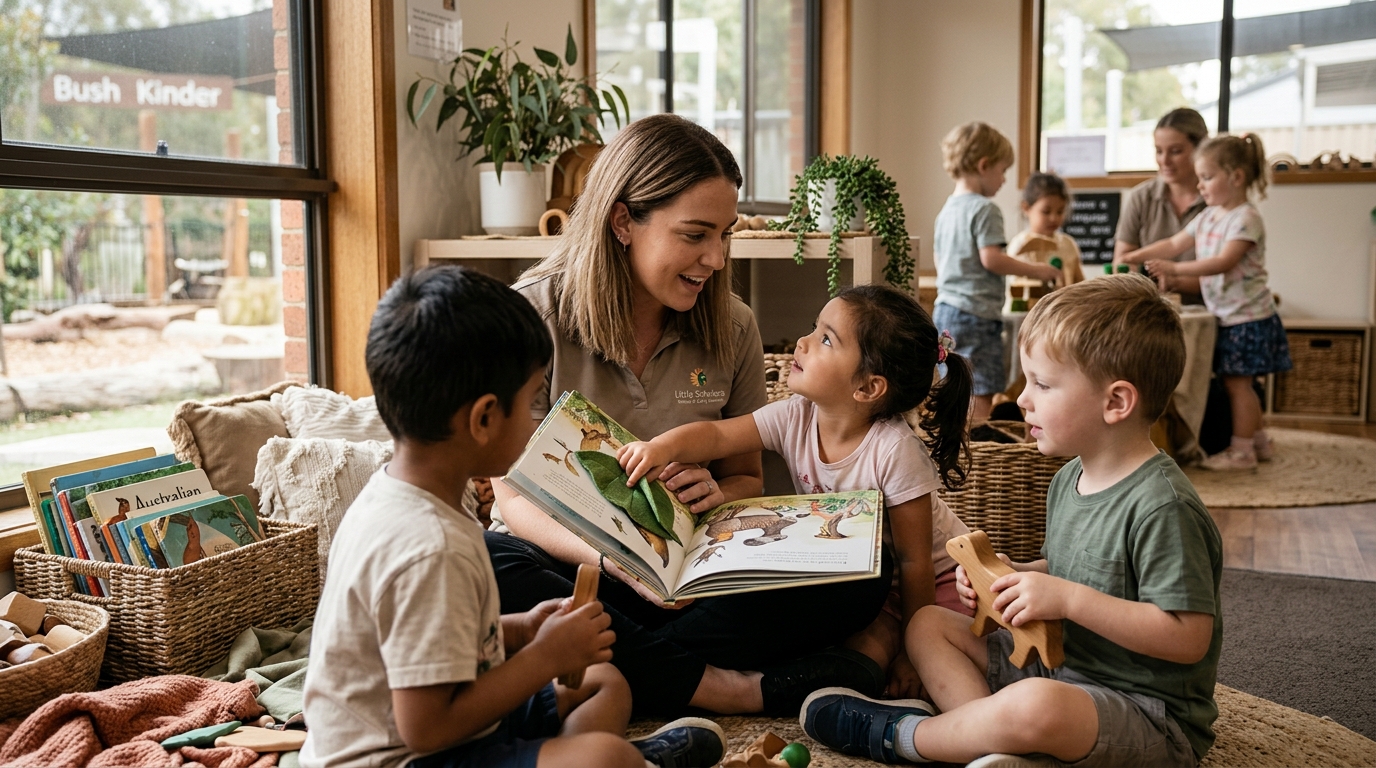
Yes. High-quality early learning services can support early literacy and language development every day—not only during a scheduled story session. At Little Scholars, language-rich learning is woven through conversations, songs, books, play, routines, outdoor exploration and intentional teaching across our childcare programs in South East Queensland. This means babies, toddlers and kindy-aged children can practise listening, communicating, understanding stories, learning new words and expressing ideas as part of meaningful everyday experiences. (Explore Little Scholars childcare in Queensland.)
In Australia, the approved Early Years Learning Framework recognises communication, language and literacy as important parts of children’s learning from birth to five years. It also requires early childhood programs to respond to each child’s developmental needs, interests, experiences and individual differences. ([acecqa.gov.au](https://www.acecqa.gov.au/nqf/national-law-regulations/approved-learning-frameworks?utm_source=openai))
The short answer: what daily literacy support looks like
Daily early literacy and language programs usually combine intentional teaching with play-based learning. Children may experience:
- Warm, responsive conversations with educators during arrivals, meals, nappy changes, handwashing and transitions.
- Shared books, songs, rhymes, storytelling and opportunities to talk about pictures and ideas.
- Print-rich play environments containing signs, labels, menus, writing materials, books and symbols.
- Games that develop listening, rhyming, sound awareness, vocabulary and turn-taking.
- Dramatic play that encourages children to negotiate roles, explain plans and use language socially.
- STEM investigations that introduce precise words such as observe, compare, balance, float and measure.
- Outdoor experiences that give children real objects, sounds, textures and events to describe and turn into stories.
- Documentation and conversations with families about emerging communication and literacy interests.
Play-based learning does not mean educators leave learning to chance. Under the EYLF, educators use intentional strategies such as modelling, questioning, explaining, speculating, demonstrating and scaffolding to extend children’s thinking and communication. ([acecqa.gov.au](https://www.acecqa.gov.au/information-sheet-eylf-practices-play-based-learning-and-intentionality?utm_source=openai))
How babies and toddlers build language before they can read
Early literacy begins well before children recognise letters. For infants, it starts with secure relationships, eye contact, shared attention, gestures, vocal play, songs and repeated conversations. An educator might name what a baby is looking at, imitate a sound, pause for a response or describe what is happening during a routine. These exchanges help children learn that sounds, facial expressions, gestures and words are meaningful ways to connect with other people.
For toddlers, educators can expand short statements into richer language. If a child says, “Truck,” an educator might respond, “Yes, the red truck is driving under the bridge.” This models grammar, descriptive vocabulary and positional language while keeping the conversation connected to the child’s interest. Little Scholars educators describe routines such as sunscreen application, handwashing and nappy changes as valuable one-to-one opportunities for talking about actions, objects and safety. ([mylittlescholars.com.au](https://mylittlescholars.com.au/proven-techniques-for-boosting-speech-development-in-early-childhood/?utm_source=openai))
In practice, a nursery or toddler program may include:
- Pointing to and naming familiar people, animals, objects and body parts.
- Singing repetitive songs and nursery rhymes.
- Sharing sturdy board books and discussing pictures.
- Pausing to let children gesture, vocalise, point or answer.
- Using simple choices, such as “Would you like the blue cup or the yellow cup?”
- Repeating important words across different experiences.
- Encouraging children to communicate needs, preferences and feelings.
The aim is not to make infants complete academic worksheets. It is to surround them with attentive adults who notice their communication and respond in ways that make language useful, enjoyable and socially rewarding.
Conversational reading with the Abecedarian Approach
One of Little Scholars’ signature literacy practices is the 3a Abecedarian Approach Australia to reading. Rather than treating a book as a script that an adult reads from beginning to end, conversational reading turns the experience into an active exchange between the child and educator.
Little Scholars describes three progressive interaction levels:
- Seeing: the child notices an object, character, image or event.
- Showing: the child points to, touches or otherwise identifies what they have noticed.
- Saying: the child attempts a word, sound, description or response.
For example, while looking at a picture book, an educator may ask, “Can you see the owl?”, then “Can you show me the owl?” and finally “Can you say owl?” The educator can then build on the child’s answer by adding related words, sounds, actions or questions.
This approach supports several early literacy foundations at once: comprehension, vocabulary, listening, turn-taking, confidence, book enjoyment and awareness that pictures and printed words communicate meaning. Little Scholars’ description of conversational reading also places comprehension and enjoyment before more formal attention to word parts, helping children develop a positive relationship with books. ([mylittlescholars.com.au](https://mylittlescholars.com.au/what-reading-looks-like-in-early-education/?utm_source=openai))
Parents can use the same method at home by following their child’s attention, asking open questions, waiting for a response and talking about the illustrations rather than trying to finish every word on every page.
Literacy through play and daily routines
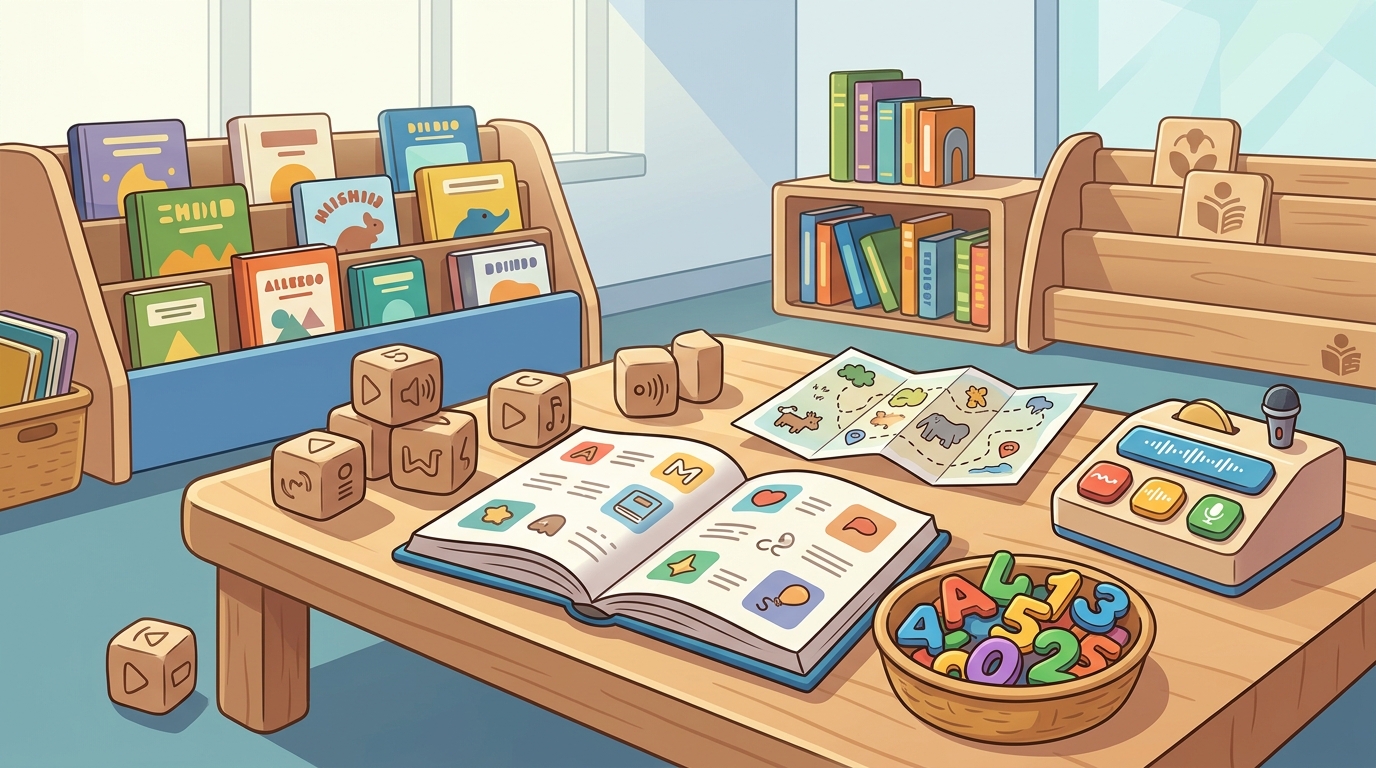
A strong daily program treats ordinary moments as learning opportunities. Children do not need to sit at a table for language learning to occur. When educators join children’s play and respond thoughtfully, children practise the language needed to describe, imagine, negotiate, remember and solve problems.
Arrival and transitions
Greetings can support name recognition, social language and confidence. Educators may talk with children about who has arrived, what the weather is like, what will happen next or how a child is feeling. Visual schedules, photographs, labels and routine symbols can help children connect spoken language with print and meaning.
Meals and cooking experiences
Mealtimes provide natural conversations about food, taste, texture, temperature, quantity and preferences. With an onsite chef preparing fresh meals, children can encounter language connected to ingredients and food experiences. A cooking or pretend-restaurant activity can extend this learning through menus, recipes, order-taking and role-play. ACECQA identifies menus in dramatic play and recipes in cooking experiences as examples of how written language can be meaningfully embedded in play. ([acecqa.gov.au](https://www.acecqa.gov.au/media/31261?utm_source=openai))
Dramatic and construction play
In home-corner play, children may create shopping lists, answer a pretend telephone, tell a story or negotiate who will be the parent, doctor or shopkeeper. In block play, educators can introduce words such as beside, underneath, higher, longer, stable and balance. These conversations connect oral language with early literacy, mathematics and problem-solving.
Music, rhyme and movement
Songs, chants and rhymes help children notice rhythm, repeated patterns and differences between sounds. They also encourage memory, participation and expressive language. Educators can pause before a familiar word, invite children to complete a repeated phrase or change the tempo and volume of a song.
Story-making and mark-making
Children can dictate a story for an educator to write, draw events from their day, make signs for a construction site or create tickets for a dramatic-play bus. These experiences show that children’s spoken ideas can be represented through drawings, symbols and written words.
Building vocabulary through STEM and outdoor learning
STEM experiences are powerful language opportunities because children have something real to investigate and explain. During water play, for example, educators may ask what children notice when an object sinks or floats, invite predictions and introduce words such as pour, full, empty, heavy, capacity and absorb.
In a building activity, children might describe a design, explain why a tower fell, compare materials or work with peers to solve a construction problem. Questions such as “What could we change?” and “Why do you think that happened?” encourage children to use longer explanations and practise the language of reasoning.
Little Scholars’ Outdoor Explorers, also known as Bush Kinder, provides another setting for rich descriptive language. Children can talk about the sound of leaves, the texture of bark, the shape of a rock, the movement of insects or the changing sky. Outdoor experiences supply sensory details that can later become drawings, shared stories, group discussions and imaginative play.
ACECQA guidance emphasises that educators can use shared thinking, questions, explanations and modelling to help children describe and explain their ideas and theories, including scientific and mathematical concepts. ([acecqa.gov.au](https://www.acecqa.gov.au/national-quality-framework/guide-nqf/section-3-national-quality-standard-and-assessment-and-rating/quality-area-1-educational-program-and-practice/standard-12-practice/element-122-responsive-teaching-and-scaffolding?utm_source=openai))
Supporting culture, home languages and inclusion
Language development is closely connected to identity, belonging and relationships. A daily program should value the languages children hear at home and create opportunities for families to share songs, stories, greetings and cultural traditions.
At Little Scholars, cultural learning includes an Acknowledgement to Country and experiences that recognise Aboriginal and Torres Strait Islander histories, cultures, stories and connections to Country. Cultural responsiveness involves respect, reflection, continued learning and a commitment to improving professional practice—not simply adding occasional cultural activities. ([acecqa.gov.au](https://www.acecqa.gov.au/quality-area-1-educational-program-and-practice-1?utm_source=openai))
For children learning English, educators can use gestures, visual prompts, repetition, objects, facial expressions, songs and peer interaction to make meaning clear. Families can help by sharing key words in the child’s home language and explaining what communication strategies work best at home. Maintaining a home language can support family connection and give children a strong foundation for expressing ideas and understanding the world.
What parents should look for in a daily literacy program
When visiting an early learning centre, ask practical questions rather than looking only for a timetable labelled “literacy”. A high-quality program may not have a long formal reading block because language learning is distributed across the day.
| What to ask | What a strong answer may include |
|---|---|
| How are books shared with children? | Interactive reading, small-group and one-to-one experiences, diverse books and questions that encourage children to participate. |
| How do educators support babies and toddlers? | Responsive conversations during routines, songs, gestures, shared attention and language matched to each child’s stage. |
| How is play connected to literacy? | Labels, signs, menus, writing tools, dramatic play, storytelling and educators who extend children’s ideas. |
| How is progress communicated to families? | Examples of children’s words, questions, stories, drawings, book interests and emerging communication goals. |
| How are home languages and cultures respected? | Family input, inclusive resources, culturally responsive practice and genuine respect for children’s identities. |
| How is intentional teaching balanced with play? | Educators plan experiences and use purposeful questions and modelling without removing children’s agency or enjoyment. |
The best program is not necessarily the one with the most worksheets or the earliest formal spelling tasks. It is the one where educators know each child, notice opportunities for communication and intentionally build on children’s interests.
Key takeaways for families
- Daily literacy is broader than reading lessons: conversation, play, songs, routines and storytelling all contribute.
- Babies benefit from language-rich relationships: naming, responding, singing and shared attention are important foundations.
- Conversational reading makes children active participants: seeing, showing and saying help connect books with communication.
- Play can be intentional: educators extend learning through questions, modelling, explanations and shared thinking.
- STEM and outdoor experiences expand vocabulary: real investigations give children meaningful reasons to describe and explain.
- Culture and home language matter: inclusive programs support belonging while broadening children’s understanding of communication.
- Families are partners: reading together, singing, talking and sharing stories at home reinforce learning at the centre.
Frequently asked questions
Are there daily programs for early literacy and language development at Little Scholars?
Yes. Little Scholars supports early literacy and language across the day through conversational reading, songs, rhymes, educator-child conversations, print-rich play spaces, storytelling, STEM experiences, outdoor learning and language-rich routines. Literacy is integrated into the broader play-based curriculum rather than limited to one isolated lesson.
What does literacy look like for babies?
For babies, literacy includes responsive interactions, eye contact, shared attention, gestures, vocal play, songs, books, repetition and educators describing what is happening. These experiences support listening, turn-taking, early comprehension and the foundations of communication.
What is the 3a Abecedarian Approach Australia?
The 3a Abecedarian Approach Australia is a conversational reading method used by Little Scholars. It encourages children to participate actively by seeing, showing and saying. Educators follow children’s attention, ask questions, allow time for responses and extend children’s words and ideas.
Does play-based learning include intentional literacy teaching?
Yes. Play-based learning and intentional teaching work together. Educators can join children’s play, introduce useful vocabulary, model language, ask open-ended questions, draw attention to rhyme and sounds, and add signs, menus, writing materials or other print in meaningful contexts. ACECQA identifies intentionality as an important part of high-quality play-based learning. ([acecqa.gov.au](https://www.acecqa.gov.au/information-sheet-eylf-practices-play-based-learning-and-intentionality?utm_source=openai))
How can educators support a child who is learning English?
Educators can use visual cues, gestures, objects, repetition, songs, predictable routines and clear language. Families can share important home-language words and cultural information so the program reflects the child’s identity and supports communication between home and the centre.
How can parents support early literacy at home?
Read together regularly, talk about pictures, sing songs, play with rhymes, describe everyday tasks, encourage children to tell stories and listen patiently when they speak. You do not need special equipment: a walk, grocery trip, bath, meal or pretend game can become a language-learning opportunity.
How can I learn more about my child’s progress?
Ask your child’s educators for specific examples of emerging vocabulary, participation in conversations, book interests, storytelling, mark-making and comprehension. Families can also discuss ways to extend the same interests at home.
See a language-rich program in action
Every child develops communication and literacy skills in their own way and at their own pace. The most useful way to assess an early learning program is to visit, observe how educators speak with children and ask how learning is planned, documented and shared with families.
Little Scholars is an award-winning, family-owned early learning provider with purpose-built campuses across the Gold Coast, Brisbane, Ipswich and Redland Bay. To see how daily literacy, language, play and school-readiness experiences come together, book a tour at a campus convenient to your family.