
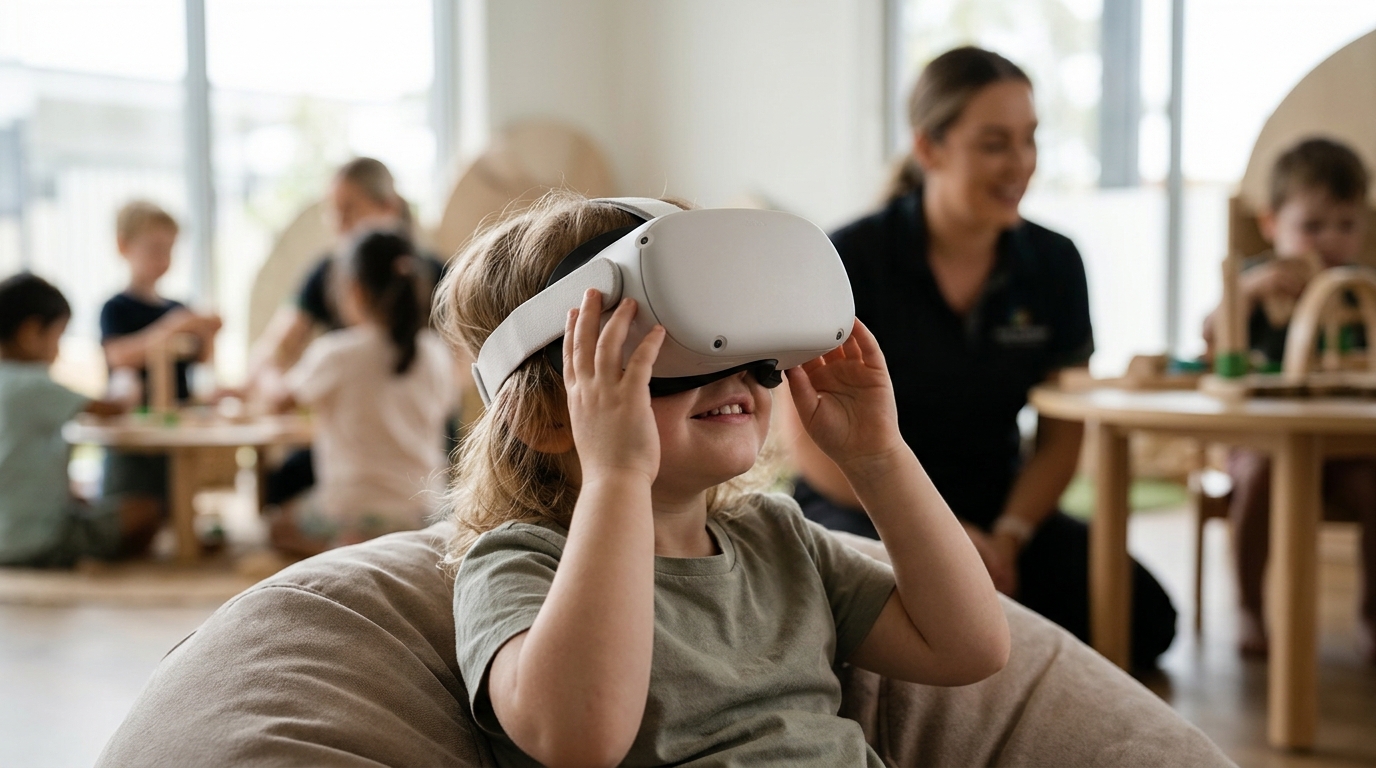
Wondernest VR is an immersive virtual reality learning experience designed specifically for early childhood education. It allows children to explore digital environments that stimulate curiosity and cognitive growth in a safe, supervised setting. At Little Scholars, this technology is integrated into our play-based curriculum to support holistic development across multiple domains.
1. Enhanced Spatial Awareness and Navigation
Children develop a stronger sense of direction and spatial relationships through interactive 3D environments. Navigating virtual spaces requires the brain to process depth, distance, and movement simultaneously. This type of engagement helps build foundational skills that support later physical coordination and mathematical understanding.
2. Stimulated Imagination and Creative Thinking
Immersive scenarios encourage children to visualize and interact with fantastical worlds. By stepping into digital landscapes, young learners practice creative problem-solving and imaginative play. This supports the development of divergent thinking, a key component of cognitive flexibility.
3. Improved Focus and Attention Span
Structured VR sessions help children practice sustained attention on specific tasks. The engaging nature of the technology captures interest without the distractions common in traditional classroom settings. Educators use these sessions to guide children through focused activities that build concentration skills gradually.
4. Early Exposure to Digital Literacy
Children learn basic digital interaction skills in a controlled and age-appropriate context. Understanding how to navigate interfaces and respond to digital prompts is an essential modern skill. Early, guided exposure helps demystify technology and builds confidence for future learning environments.
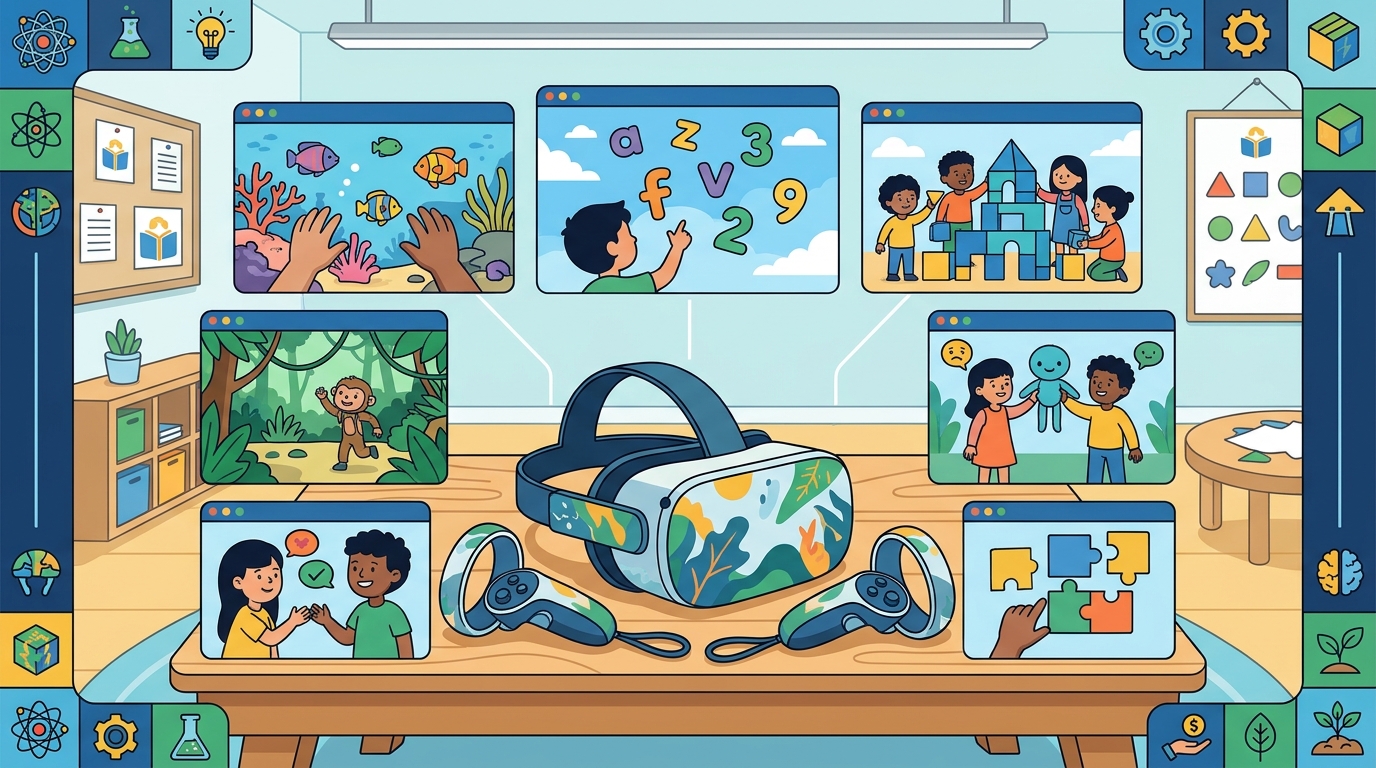
5. Social Interaction and Collaborative Play
Group VR experiences foster communication and teamwork among peers. When children explore virtual environments together, they practice sharing ideas, taking turns, and solving problems collaboratively. This supports the development of social skills and emotional intelligence in a low-pressure setting.
6. Sensory Engagement and Multisensory Learning
7. Safe Exploration of Complex Concepts
Children can explore abstract or complex ideas in a risk-free digital space. Concepts that might be difficult to demonstrate physically, such as space travel or underwater ecosystems, become accessible and tangible. This allows educators to introduce new topics in an engaging way that sparks curiosity without safety concerns.
Choosing the Right Approach for Your Child
When considering VR experiences for your child, look for programs that are age-appropriate, educator-led, and integrated into a broader play-based curriculum. At Little Scholars, Wondernest VR is one component of our comprehensive early learning approach, designed to complement rather than replace traditional play and interaction. The key is balance: technology should enhance, not dominate, a child's developmental journey.
Frequently Asked Questions
Is Wondernest VR safe for young children?
Yes, when used in a supervised, age-appropriate context. At Little Scholars, sessions are guided by qualified educators who monitor screen time and ensure the experience is comfortable and beneficial for each child's developmental stage.
How often do children use Wondernest VR at Little Scholars?
Usage is integrated into the weekly curriculum and varies by age group and program. Educators balance VR sessions with other activities to ensure a well-rounded learning experience that includes physical play, social interaction, and creative exploration.
Does VR replace traditional play-based learning?
No, VR is a supplement to, not a replacement for, traditional play-based learning. At Little Scholars, our core curriculum remains grounded in play, exploration, and social interaction. VR is one tool among many used to enrich specific learning objectives.
What age group is Wondernest VR suitable for?
The program is designed for early childhood learners, typically from preschool age upwards. Specific suitability depends on the child's individual developmental readiness and comfort level, which educators assess before introducing the technology.
How does Wondernest VR support school readiness?
By developing skills such as focus, spatial awareness, digital literacy, and problem-solving, VR experiences can support the cognitive foundations needed for school. However, school readiness is built through a holistic approach that includes social, emotional, and physical development, not just technology exposure.
Can parents see what their child is doing in VR sessions?
Experience Wondernest VR at Little Scholars
Discover how immersive learning can complement your child's early education journey. Explore our Wondernest VR program or book a tour of one of our 18 campuses across South East Queensland to see how we integrate technology into a play-based, holistic curriculum.