
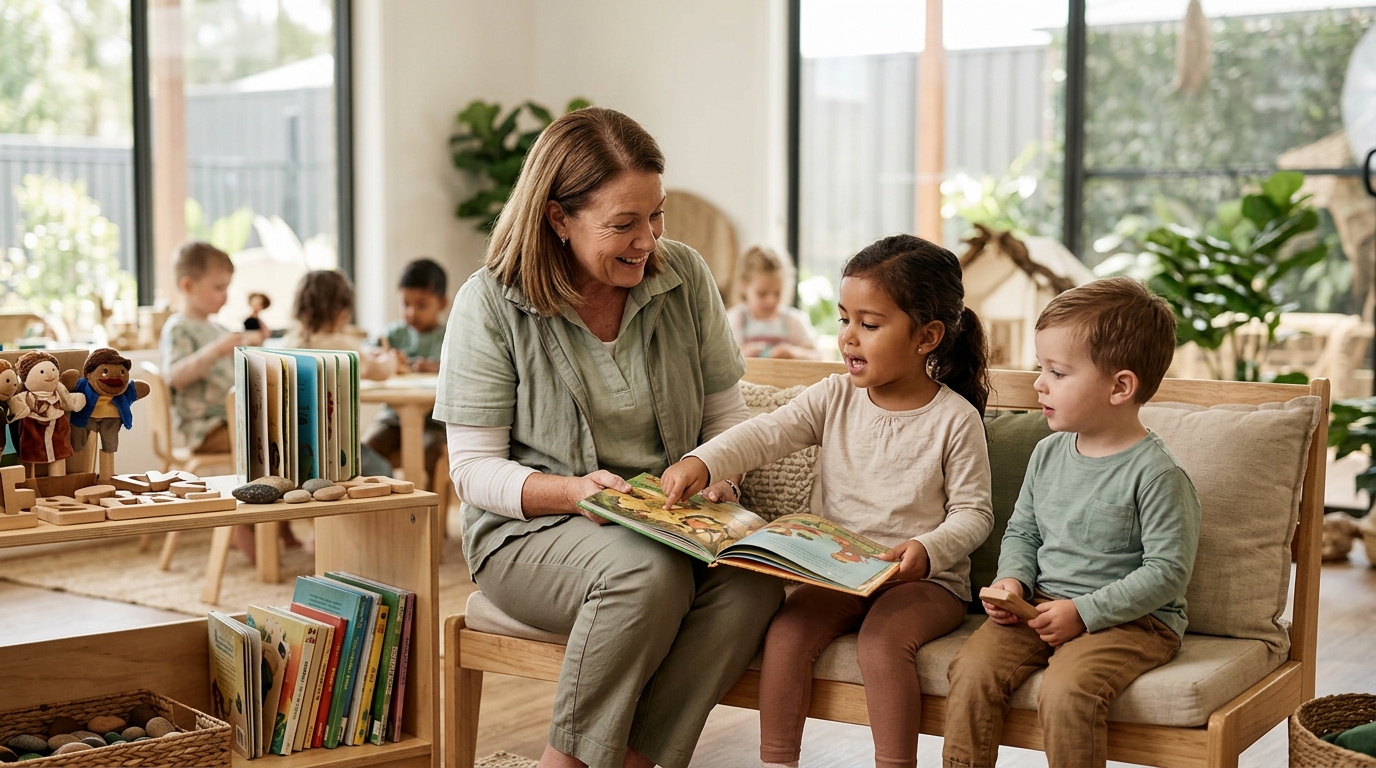
Most parents assume "teaching a child to read" means flashcards, sound-out drills, and workbooks eventually. At Little Scholars, the starting point is almost the opposite: a conversation. Long before a child decodes their first word, they're learning that books are something you talk about together — pointing, naming, asking, answering — and that back-and-forth is where real literacy actually begins. This guide explains the specific, research-grounded approach behind that philosophy and how it shows up in the daily rhythm of a Little Scholars campus. (Childcare Queensland Little Scholars)
The Foundations of Our Literacy Approach
At Little Scholars, we believe that literacy is not just about decoding words. It is about understanding the world through language. Our approach is rooted in the belief that play-based learning is the most effective vehicle for cognitive growth. The Australian Early Years Learning Framework emphasizes that children become successful learners through rich language and literacy experiences. We aim to put this into practice by training educators to notice and build on each child's language milestones.
Our campuses across Brisbane, the Gold Coast, Ipswich, and Redland Bay are designed to be print-rich environments. From labeled resources to visible word walls, the physical space itself acts as a silent teacher. However, the real work happens in the interactions. We prioritise intentional teaching, where educators actively engage children in conversations that extend their thinking and vocabulary.
We also embed Indigenous culture into our language programs. By including Acknowledgement of Country and First Nations storytelling, we aim to help our Little Scholars develop respect for diverse linguistic and cultural traditions. This cultural competence is a valued part of holistic development.
The Abecedarian Reading Curriculum
One of the most distinctive parts of our curriculum is the 3a Abecedarian Approach Australia, often shortened to Abecedarian Reading. It's worth being precise about what this actually is: it's not primarily a phonics drill. It's a conversational reading method, built on back-and-forth dialogue between adult and child around a book, structured across three progressive levels — seeing, showing, and saying.
The approach traces back to the original Abecedarian Project, a controlled scientific study begun in the 1970s that followed children from disadvantaged backgrounds through an intensive early-education intervention from infancy to age five. That research found lasting benefits to cognitive and academic development, and specifically highlighted the value of language-rich, conversational interactions between educators and children — which is the core idea Little Scholars has built its own reading approach around.
In practice, that means an educator reading with a child won't just recite the words on the page. They'll pause to ask "Can you see the owl?", invite the child to point or name what they see, and let the conversation branch out from there. Comprehension and connection to the story come first; more formal "word part" skills are layered in once a child has that foundation. Working with families is treated as a core part of the approach too — Little Scholars sends home materials to help parents use the same conversational technique at home.
We also use digital tools to broaden this experience. Our Wondernest VR program lets children explore virtual environments — from walking with dinosaurs to diving underwater — introducing new vocabulary and concepts that spark curiosity and further conversation.
Daily Routines That Build Vocabulary
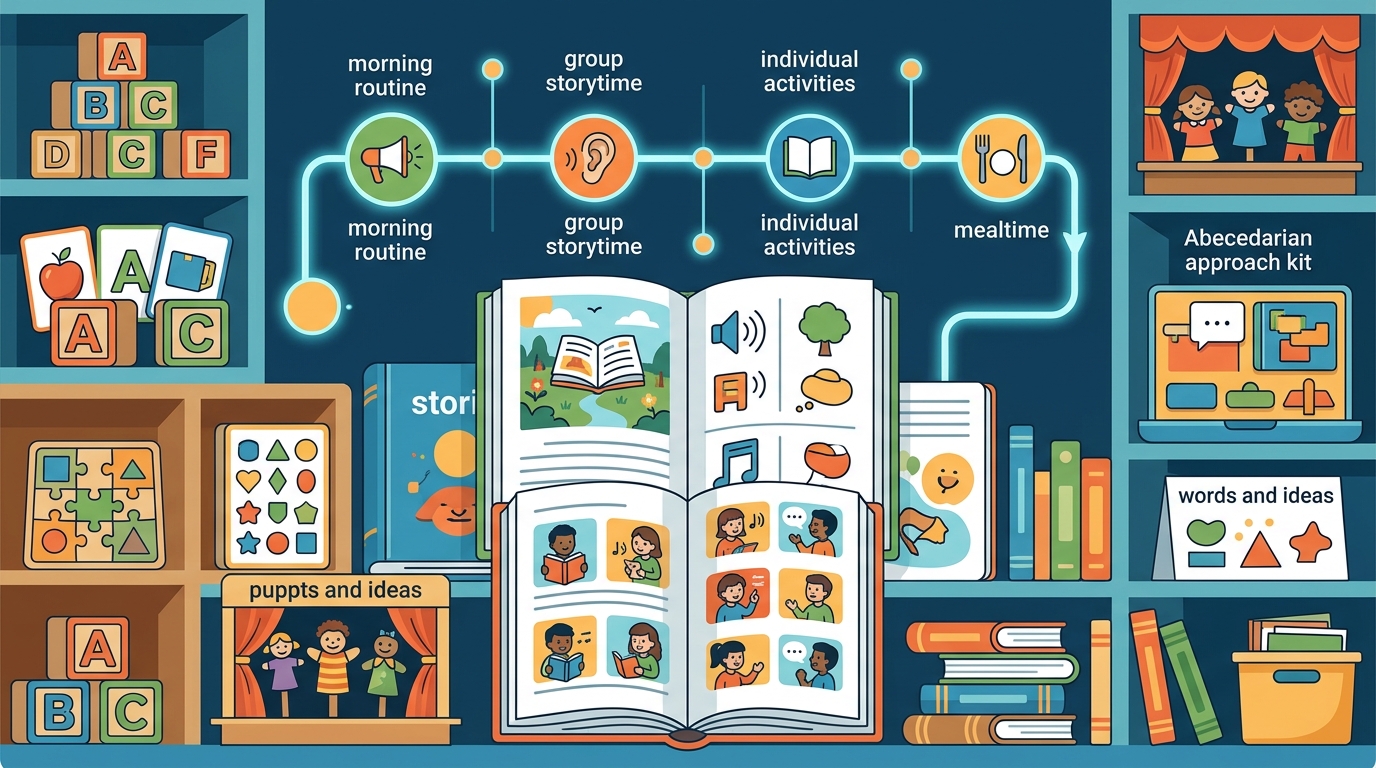
Literacy development at Little Scholars is not confined to a specific "reading time." It is embedded in the daily rhythm of the center. Here is how we support language development through routine:
Morning Circle and Story Time
Every day begins with a morning circle where children gather to sing, share, and listen. This routine builds listening skills and community awareness. Story time is a cornerstone of our day. Educators select books that reflect the diversity of our families and the world around us, and use the same conversational technique described above — asking open-ended questions like, "What do you think will happen next?" or "How do you think the character feels?" This promotes critical thinking and emotional intelligence alongside language skills.
Outdoor Explorers (Bush Kinder)
Our Outdoor Explorers program takes learning into the natural environment. In the bush, language becomes descriptive and sensory. Children learn words related to nature, texture, and space. They negotiate roles in imaginative play, which requires more complex sentence structures and collaborative language. This unstructured play supports social language skills in a way that's harder to replicate indoors.
Nutrition and Meal Times
Meal times are often overlooked as learning opportunities. At Little Scholars, we treat them as prime moments for conversation. Educators discuss the foods being eaten, encouraging children to describe tastes, textures, and origins. This expands descriptive vocabulary and introduces concepts of health and nutrition, while also encouraging children to express their preferences and needs.
STEM and Language Integration
Science, Technology, Engineering, and Mathematics (STEM) are not separate from literacy — they're closely connected. Our STEM education initiatives ask children to use language to hypothesise, predict, and explain what they observe.
Our annual Little Scholars Science Fair — a whole-organisation event bringing together children, families, and educators from across our campuses — gives children a chance to explore hands-on experiments and demonstrations, talking through what they're seeing and doing with peers, educators, and family members along the way. That kind of informal, in-the-moment explaining builds confidence and clarity of thought just as much as a formal presentation would.
We also integrate technology into STEM learning. Children use tablets to document their observations, creating digital stories that combine images and text, introducing them to the idea that meaning can be made through both pictures and words together.
Program Features Overview
To help you understand the breadth of our literacy support, here is a summary of the key components of our daily programs:
| Program Component | Focus Area | Developmental Benefit |
|---|---|---|
| Abecedarian Reading (3a Approach) | Conversational, Dialogic Reading | Builds comprehension and language connection ahead of formal decoding skills. |
| Bush Kinder | Nature-Based Vocabulary | Enhances descriptive language and sensory awareness. |
| Wondernest VR | Digital Literacy & Exploration | Introduces new concepts through immersive visual experiences. |
| Story Time Circles | Comprehension & Empathy | Develops listening skills and emotional intelligence. |
| STEM Projects & Science Fair | Scientific Discourse | Encourages hands-on exploration and explanatory language. |
Key Takeaways
- Abecedarian Reading: Our reading approach is a conversational, dialogic method — not a phonics drill — built on the research-backed Abecedarian Project.
- Daily Integration: Literacy isn't isolated. It's woven into meals, outdoor play, and morning circles to maximise exposure.
- Cultural Inclusion: Our programs include Acknowledgement of Country and First Nations storytelling, fostering respect for diverse linguistic traditions.
- STEM Connection: Science activities like our annual Science Fair get children using language to explain and describe what they discover.
- Technology Use: Tools like Wondernest VR provide immersive experiences that expand vocabulary beyond the immediate classroom.
- Family Involvement: The Abecedarian approach is designed to work at home too, and we share resources to help families use it there.
- Qualified Educators: Our team is trained to notice individual language milestones and provide targeted support for each child.
Frequently Asked Questions
How does Little Scholars support children who are still developing basic speech?
We use a differentiated approach. Educators assess each child's current level and provide targeted support, such as simplified language, visual aids, and one-on-one interaction, to help them build confidence and vocabulary at their own pace.
Is the Abecedarian Reading program used in all age groups?
The conversational reading technique itself is used from Nursery and Infant Care onwards, since it's built around everyday interaction rather than formal instruction. It becomes a more structured, named part of the curriculum as children move into Junior and Senior Kindy.
How can I support literacy development at home?
We share resources and tips directly with families to extend the same conversational reading technique used at our campuses. We encourage daily reading, asking open-ended questions, and engaging in imaginative play at home.
Do you incorporate Indigenous languages into your curriculum?
Yes. We incorporate Acknowledgement of Country, local language, stories, and cultural practices into our daily programs, aiming to help our Little Scholars learn about and respect First Nations culture.
How do you track a child's literacy progress?
Educators document observations and track milestones in comprehension, vocabulary, and language use, sharing these updates with parents during regular reviews.
What role does play have in learning to read?
Play is the primary vehicle for learning. Through dramatic play, children experiment with language roles, negotiate scenarios, and use symbols to represent ideas — all critical precursors to formal reading and writing.
Are there opportunities for children to practice public speaking?
Yes. Events such as our annual Science Fair give children informal, low-pressure opportunities to talk through what they've made or discovered with peers and family members.
Schedule Your Campus Tour
Understanding the daily literacy programs at Little Scholars is the first step in choosing the right environment for your child. We invite you to see our approach in action. By visiting one of our campuses in Brisbane, the Gold Coast, Ipswich, or Redland Bay, you can observe our educators in action and ask detailed questions about our curriculum.
Book a tour today to experience the Little Scholars difference. Let us help your child build a lifelong love of reading and language.